
When hotel owners start thinking about selling, one of the first questions is often:
Should I list the hotel publicly, or try to sell it off-market?
There are legitimate reasons to keep a hotel sale confidential. But from what I see, many owners choose the off-market route for reasons that sound reasonable at first, but don't hold up very well in practice.
And secrecy comes with a significant cost.
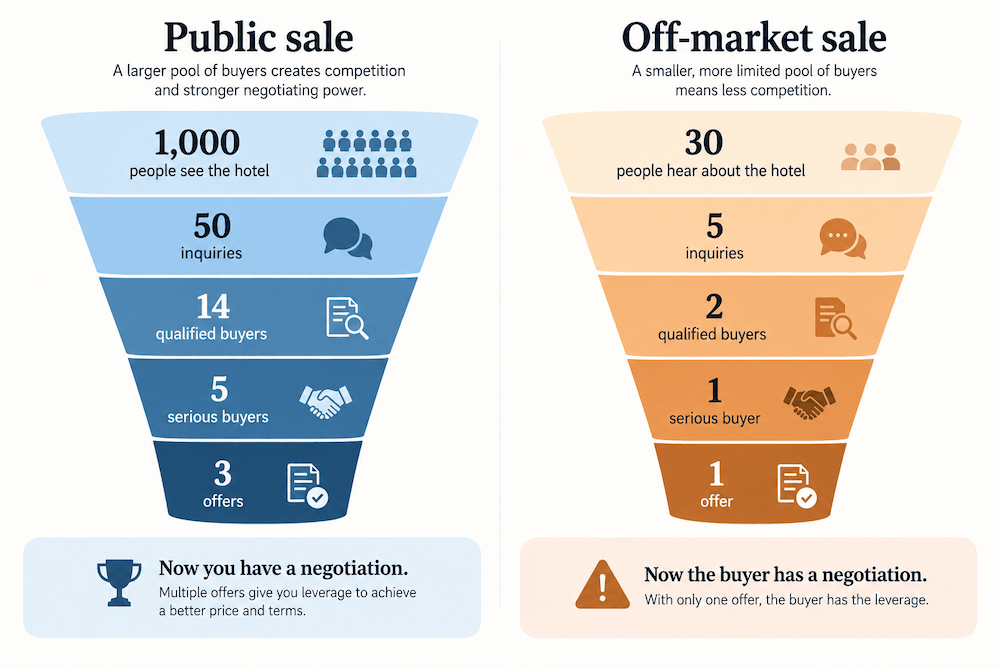
When you sell off-market, fewer buyers know your hotel is available. Fewer buyers means less competition. Less competition usually means less negotiating power for you.
Before deciding to keep your sale secret, it's worth understanding exactly what you're giving up.
This is probably the most common reason I hear.
Owners worry that once employees discover the hotel is for sale, they'll start looking for other jobs. Motivation will disappear. Service quality will decline. The operation will suffer precisely when the hotel needs to look its best.
I understand the concern. The problem is that your employees will probably find out anyway.
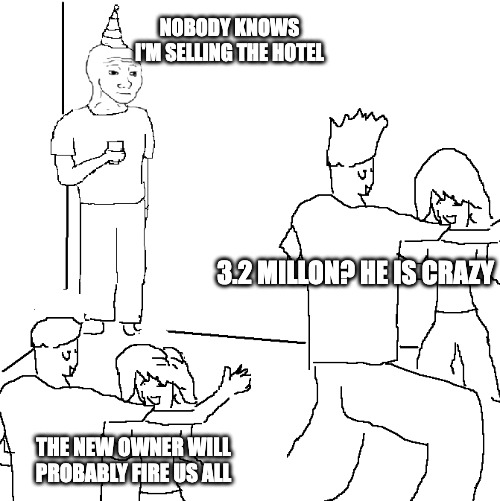
Selling a hotel isn't something that's particularly easy to hide for months.
Potential hotel buyers visit, advisors ask questions, documents get prepared, due diligence happens, people in a small hospitality market talk. Eventually, someone hears something.
And there is an even worse scenario: you think your employees don't know, but everybody already knows.
Now your team isn't only worried about what will happen. They also know you're hiding something from them.
A better approach: prepare the message.
Instead of trying to hide the sale, prepare your communication properly. Explain why you're selling.
Maybe you've operated the hotel for 15 or 20 years. You're tired. Your motivation isn't what it used to be. Your employees probably notice that already.
A new owner could actually be good news for them. A motivated buyer might invest in the property. They might bring more hospitality experience. Employees might have more opportunities to grow. Salaries could improve. The hotel itself could become better.
You don't need to promise things you can't control. But you can explain that your objective isn't simply to get rid of the hotel. It's to find a good new owner who can take it into its next chapter.
Also explain what happens if the hotel doesn't sell. Will you continue operating it? For how long? What does that mean for the team?
Give people as much certainty as you reasonably can. It requires some courage and probably swallowing a little bit of ego. But in many cases, managing the communication is better than trying to manage a secret.
If employees are your main reason for selling off-market, I'd reconsider.
This happens frequently with family-owned hotels.
Perhaps five family members own the property. One person actively manages it, while the others have different opinions about what it's worth, whether it should be sold, and what they should do next.
The temptation is understandable: Let's find a buyer first. Then, when we have a real offer on the table, we'll present it to everyone.
There are situations where this strategy can work, but it's risky.
Imagine spending months finding a serious buyer. They analyze the hotel, visit the property and make an offer.
Then you tell them: "Great. Now I just need to convince the rest of my family that we're actually selling."
That's not exactly confidence-inspiring. Even worse, one of the other owners might suddenly decide the price isn't high enough. Another doesn't want to sell at all. Someone wants to wait another year.
And the deal you've spent months building disappears.
Do the difficult conversation first.
Before going to market, prepare properly.
Put together:
Then sit down with the other owners. There will probably be disagreements. That's fine. Have them now.
Because if you can't reach alignment before you have a buyer, why do you expect to magically reach alignment after you have one? A serious buyer wants to know that the sellers are actually capable of selling.
This is another surprisingly common reason. You don't want your neighbors to know. You don't want competitors to know. You don't want everyone in the village discussing why you're selling.
My question would be: So what?
People sell hotels for hundreds of reasons. Maybe the business is performing extremely well and you want to realize the value you've created. Maybe you're retiring. Maybe you want to invest in something else. Maybe you're tired of operating a hotel. Maybe the hotel isn't performing well and you've decided someone else would be a better owner.
There is nothing inherently embarrassing about selling a hotel.
Keeping the sale secret simply because you're worried about what other people might think can become a very expensive ego problem. Especially because those same people you're hiding the sale from could be your best buyers.
The biggest problem with off-market sales: you lose local buyers.
This is one of the most underestimated disadvantages of selling off-market: Your buyer might already be nearby.
It could be a competing hotel owner who wants another property. It could be someone operating restaurants or other hospitality businesses in the region. It could be a local entrepreneur looking to diversify. It could be a wealthy family or family office that understands the area extremely well.
These buyers already know the destination. They understand demand, seasonality, staffing and local real estate. They might even know your hotel. That can make them excellent buyers.
But if nobody locally knows the hotel is available, you're effectively removing them from the process.
Instead, an off-market strategy often means quietly approaching investors elsewhere in the country or abroad while ignoring potentially excellent buyers sitting 20 kilometers away. That's a significant trade-off.
Think about selling your hotel as a funnel. At the top, you want maximum relevant exposure.
A large number of potential buyers see the opportunity. Some request more information and you qualify them.
A smaller number receive detailed financial information. An even smaller number visit the property. Several might make offers and then you negotiate.
The mistake many owners make is worrying too much about having "too many people" see the hotel for sale. That's exactly what you want.
You don't need to give confidential information to everyone. You can control access to sensitive financials, owner information and detailed documents later in the process.
But you want the opportunity itself to reach as many credible potential buyers as possible.
Owners sometimes tell me: "I already have someone interested."
That's useful. But having one buyer is very different from having a market.
If that buyer knows they're the only serious party, they have leverage:
And if they walk away, you're back at zero. The objective shouldn't simply be to find a buyer.
The objective should be to create enough competition that you can identify the best buyer at the best terms.
A properly prepared public listing gives you a much better chance of doing that.
There is one situation where I'm much more sympathetic to an off-market sale: You're not actually sure you want to sell.
Maybe your hotel is worth €3 million according to comparable transactions, but you'd happily sell it for €4 million.
You don't want to launch a full sales process. You simply want to test whether someone out there is willing to pay your number.
I see this quite often at BuyThatHotel. Owners essentially say:
"I'm not motivated to sell, but if somebody offers me this price, I'll do it."
That's completely different from someone who has genuinely decided to exit. In this situation, an off-market approach can make sense.
You can quietly test demand without announcing to employees, competitors and the entire market that the hotel is for sale.
There is one catch.
Good hotel brokers will usually recognize pretty quickly when you're testing the waters rather than seriously trying to sell. Their business depends on successful transactions, so many won't want to spend significant time marketing a property with an unrealistic price and an uncommitted seller.
In that case, trying the off-market approach yourself may actually be the most logical option.
There isn't anything inherently wrong with selling a hotel off-market. The question is why you're doing it.
If confidentiality genuinely has substantial economic or legal value, accepting lower exposure may be worthwhile.
If you're simply testing whether somebody will pay an unusually attractive price, off-market can also be a sensible strategy.
Peter Fabor is a hospitality entrepreneur with 15+ years of experience building niche businesses across hotels, coliving, coworking, retreats, and hospitality tech. He is the founder of Surf Office, Buy That Hotel, Hotel Nuggets, and Pingotel. His work focuses on identifying underserved hospitality markets and building businesses around them.