
If you have already successfully sold a hotel, you probably don't need to read this article.
But if you're preparing to sell one, there are a few mistakes I see hotel owners making repeatedly, especially owners of smaller independent hotels who might be going through this process for the first time.
Here are seven of the most common ones.
When you sell a hotel, you are actually selling two different assets: the real estate and the hospitality business operating inside it.
These two assets should not necessarily be valued in the same way.
The real estate is relatively straightforward. You can ask a local commercial real estate agency or professional valuer to estimate the value of the building and land based on the location, size, condition, comparable transactions and potential alternative uses.
The hospitality business needs to be evaluated separately, because its value depends on completely different factors, including profitability, historical growth, stability of earnings, repeat customers, direct bookings, customer database, reputation, operating systems and how dependent the business is on the current owner.
A common mistake among small hotel owners is to combine everything into one number and simply say that the hotel is for sale for €2 million, without being able to properly explain how that €2 million valuation was calculated.
.png)
A better approach is to understand the value of each asset separately. Perhaps the real estate is worth €1.4 million and the operating business is worth another €400,000. You now have a valuation that is much easier to explain and defend during negotiations.
Separating the two also opens up more possibilities when selling, because the buyer of the real estate does not necessarily have to be the company that operates the hotel. One investor might own the property while another company leases it and runs the hospitality business, which is a very common structure in the hotel industry.
It also helps you understand who your potential buyers are, because different types of hotel buyers will look at the real estate and operating business very differently.
Every hotel has problems, and trying to hide them because you are worried they will reduce the sale price usually creates a much bigger problem later.
Maybe there is a permit issue, part of the property requires substantial renovation, one year of financial performance was particularly bad, there is a dispute with a neighbor, or you have an unfavorable contract that cannot easily be terminated.
The temptation is to disclose these things as late as possible, hoping that by then the buyer will already be sufficiently committed to the transaction.
In reality, you are usually just postponing the problem until due diligence.
Professional buyers will almost certainly discover important issues because they will have lawyers, accountants, engineers and other specialists checking the property and the business. Less experienced buyers can sometimes be even more sensitive because they don't have enough experience to distinguish between a normal problem that can be solved and a serious reason to abandon the acquisition.
Once a buyer discovers something important that you deliberately didn't disclose, the discussion is no longer only about the original problem. They also start questioning what else you might not have told them, which can damage trust in the entire transaction.
It is generally better to identify important issues before the sale, disclose them at the appropriate stage and, whenever possible, already have an explanation or solution prepared.
Many owners automatically assume that selling their hotel off-market is somehow better because they can control who knows about the sale and speak only with supposedly qualified buyers.
There are legitimate reasons to keep a transaction confidential, particularly with very large or high-profile properties, but for most small independent hotels, excessive secrecy works against the seller.
When selling a hotel, you generally want as many relevant people as possible to know that the opportunity exists. Some of them will never buy your hotel, but they might send the listing to a friend, share it in a WhatsApp group, mention it to another hotel owner or know an investor who has been looking for exactly this type of property.
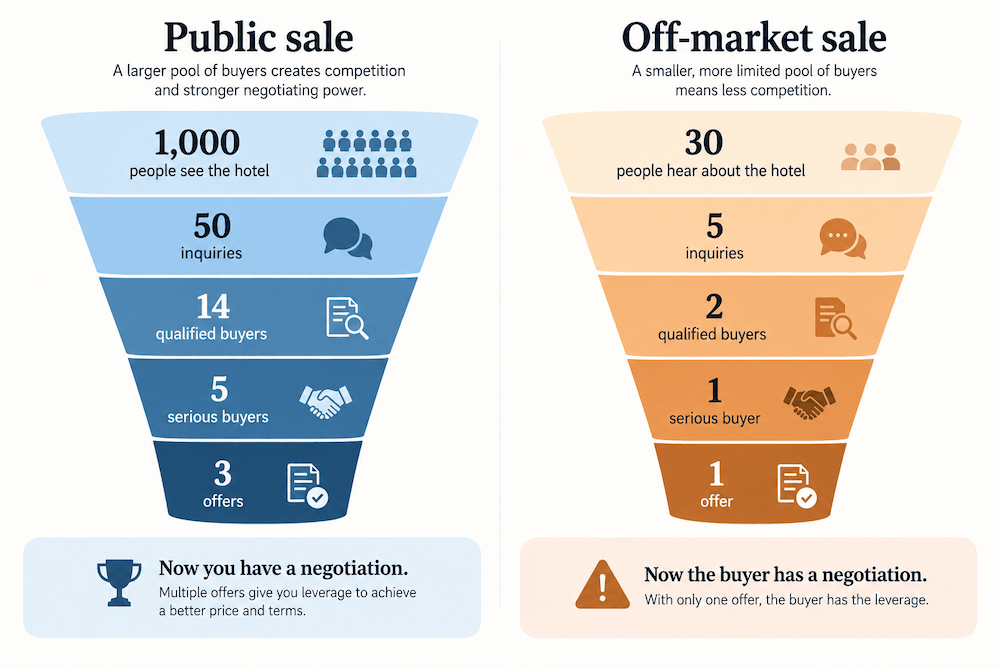
Qualified buyers are not sitting in a special database waiting for hotel brokers to contact them. They are also on Instagram, LinkedIn, WhatsApp and other places where information about interesting properties gets shared.
There are exceptions. If you are selling a €300 million resort in Spain or a large hotel in central Amsterdam, the number of realistic buyers might be relatively small and a good advisor can probably identify most of them directly.
For a 10-room or 20-room independent hotel, however, the potential buyer could come from many different places, and limiting exposure can mean eliminating the person who would have ultimately made the best offer.
I wrote a separate article about the advantages and disadvantages of selling your hotel off-market versus publicly.
Broker commissions can look expensive, so it is understandable that some hotel owners consider selling the property themselves.
The problem is that a good hotel broker does much more than publish a listing and introduce you to potential buyers. They help prepare the property for sale, establish a realistic valuation, identify buyers, qualify inquiries, coordinate the sales process, negotiate offers and keep the transaction moving when problems appear.
Those problems are almost guaranteed to appear at some point because hotel transactions involve due diligence, lawyers, financing, property documentation, operating companies, licenses, negotiations and multiple parties who all have slightly different interests.
Trying to save the broker's commission can therefore become expensive if you end up accepting a lower offer, negotiate poor terms or lose a good buyer because the process was badly managed.
Selling without a broker can make sense if you have sold hotels before, have an experienced advisor helping you, or aren't actually committed to selling and simply want to test the market. For example, you might want to understand the property's valuation before buying out a partner or selling only part of the business.
If you genuinely want to sell the entire hotel, however, working with someone who understands hotel transactions will usually make sense.
The important part is choosing the right person, because there are very different types of hotel brokers, and the broker who is excellent at selling a 200-room city hotel might be completely wrong for a 12-room countryside property.
Of course the price matters, but sellers often spend too much time deciding what number they want and not enough time thinking about the process that could actually produce the highest price.
You might decide that your hotel is worth €3 million and then spend the next year trying to convince buyers that €3 million is the correct number. The problem is that your desired price does not determine what the market is willing to pay.
A better strategy is to focus on creating the strongest possible sales process.
You want enough potential buyers entering the funnel, enough qualified buyers reviewing the opportunity, several serious buyers visiting or conducting due diligence, and ideally multiple buyers reaching the point where they are prepared to make an offer.
When several credible buyers are interested at approximately the same time, you have much more negotiating power than when you spend six months negotiating with a single buyer who knows there is nobody else waiting.
This is ultimately how you discover the maximum price the market is willing to pay for your hotel. Setting an ambitious asking price does not automatically create a high valuation, while creating genuine competition between buyers can.
Don't become too attached to one number before the market has had an opportunity to tell you what the property is worth. Focus instead on building the process that gives you the best chance of achieving the highest possible price and the best possible terms.
One of the easiest mistakes to avoid is going to market before you have prepared the information that serious buyers will inevitably request.
A buyer asks for three years of financial statements, but you only have two available. They ask for floor plans, and you need several weeks to find them. They ask about permits, licenses, occupancy, ADR or payroll costs, and every question requires another conversation with your accountant or another search through old files.
Individually, none of these problems seems particularly serious, but together they tell the buyer that the seller is not prepared.
Before putting the hotel on the market, you should prepare a proper data room containing the important financial, operational, property and legal information that buyers are likely to request. Depending on the property, this could include historical P&Ls, revenue and occupancy data, ADR, payroll information, property documents, permits, licenses, floor plans, renovation history, major contracts, equipment inventories, utility costs and expected future CapEx.
This becomes particularly important when dealing with professional hotel buyers, who are accustomed to structured acquisition processes and will expect the seller to provide reliable information relatively quickly.
Good buyers usually have multiple investment opportunities available to them, so if evaluating your hotel becomes unnecessarily difficult, some will simply move on to another property.
Others might remain interested but start pricing the inconvenience and uncertainty into their offer. If they believe the transaction will require significantly more work than expected, they will want to be compensated for that additional risk.
Broker exclusivity is a tricky subject because there are good reasons why brokers want it, but there are also good reasons why sellers should be careful before agreeing to it.
Most hotel brokers primarily make money when a transaction closes, which means they can spend months preparing sales materials, contacting buyers, arranging calls and viewings, answering questions and negotiating without knowing whether they will eventually receive a commission.
If the same hotel is being offered by several competing brokers, each broker has a much lower probability of getting paid, so the best and busiest brokers are naturally less willing to invest significant time into the property.
For that reason, exclusivity itself is not necessarily a bad thing. In many cases, if you want a very good broker to invest serious effort into selling your hotel, some form of exclusivity will be required.
The risk comes from committing yourself for too long before you know whether the broker is actually the right one.
A broker might look excellent during the initial conversations but later turn out to have the wrong buyer network, insufficient experience with your type of property or simply not enough time to properly manage the sale. If you discover this three months into the process but have signed an exclusivity agreement for two years, you have created a serious problem for yourself.

Before signing, understand how long the exclusivity lasts, what the broker is actually committing to do, how the property will be marketed, how frequently you will receive updates and under what circumstances you can terminate the agreement.
You should also understand what happens with buyers introduced during the exclusivity period and whether the broker remains entitled to a commission if one of those buyers purchases the hotel after the agreement has ended.
A good broker needs enough security to justify investing time and resources into your sale, but you also need a reasonable way out if the relationship clearly isn't working.
Most of these mistakes happen because hotel owners naturally spend most of their time thinking about the property and the price, while buyers and brokers are looking at the entire transaction.
Before putting your hotel on the market, understand exactly what you are selling, create a realistic valuation for both the property and the operating business, prepare your documentation, decide which types of buyers are most relevant, choose the right hotel broker, and decide whether a public or off-market sale makes the most sense.
The objective is not simply to find one person who is willing to buy your hotel. You want to create a professional sales process that attracts several credible buyers, gives them enough information to make decisions efficiently and puts you in the strongest possible position when it is time to negotiate.
Peter Fabor is a hospitality entrepreneur with 15+ years of experience building niche businesses across hotels, coliving, coworking, retreats, and hospitality tech. He is the founder of Surf Office, Buy That Hotel, Hotel Nuggets, and Pingotel. His work focuses on identifying underserved hospitality markets and building businesses around them.