
Selling a hotel is quite different from selling a house or apartment because you are usually selling several things at the same time: the real estate, an operating hospitality business, existing cash flow and, in many cases, the potential to do much more with the property than the current owner is doing.
This is why simply putting the hotel on a real estate website, adding a few photos and waiting for inquiries is rarely a good strategy. Before going to market, you should understand who is most likely to buy your hotel, what exactly you are selling to them and how you can create enough interest to get a good price.
Here is the process I would follow.
Once a serious buyer becomes interested, they will start asking for information about the property, the business, its financial performance and its legal situation. You don't want to start searching for documents every time a new question arrives, so prepare as much as possible before putting the hotel on the market.
Your data room should include financial statements, revenue and occupancy history, property documentation, floor plans, permits, licenses, ownership information, room inventory, renovation history, important contracts, information about employees, booking channels, direct booking performance and future reservations.
The exact documents will depend on the property and country, but the principle is simple: try to anticipate the information that a serious buyer and their advisors will eventually request.
At the same time, prepare a professional sales deck that presents the hotel visually and makes the opportunity easy to understand. If you are not working with a broker who can do this properly, consider hiring a designer to help you. If you are selling an asset worth hundreds of thousands or millions of euros, spending some money on a professional presentation is a relatively small investment.
Good preparation also signals to the buyer that the business itself is organized. A messy data room, missing documents and inconsistent numbers immediately create additional uncertainty.
The first decision is whether you want to sell your hotel publicly or keep the sale off-market.
In most cases, I prefer a public sale because more exposure means more potential buyers, and having several interested buyers gives you a much better negotiating position. If 1,000 people see your hotel instead of 30, there is simply a higher probability that you will find several serious buyers who start competing with each other.
There are legitimate reasons for selling off-market. Maybe confidentiality is extremely important and you really cannot afford employees, competitors or suppliers finding out about the sale. You might also have several specific buyers in mind, or perhaps you are not fully committed to selling yet and simply want to test the market.
The important thing is to understand the trade-off. By selling off-market, you are deliberately reducing the number of potential buyers who can discover the property, so there should be a good reason for doing it.
I wrote a separate article about selling your hotel off-market versus publicly, including the situations where each approach makes sense.
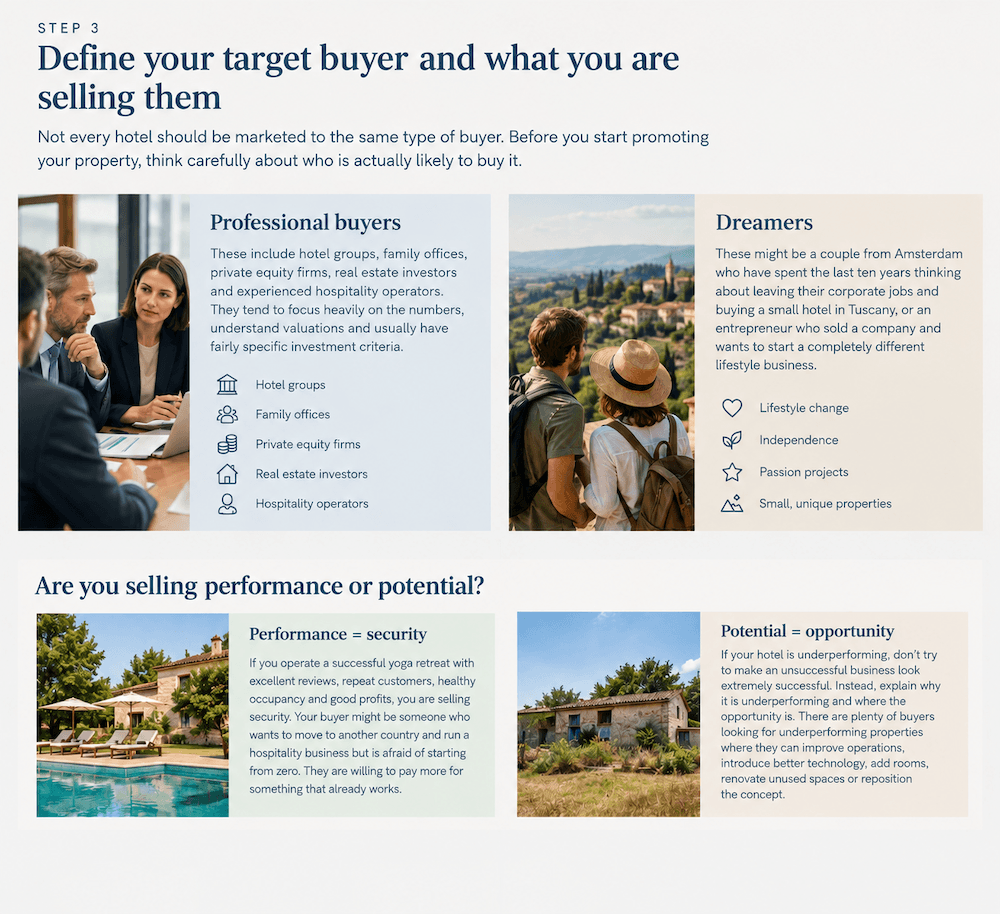
Not every hotel should be marketed to the same type of buyer, so before you start promoting the property, think carefully about who is actually likely to buy it.
Broadly speaking, I divide small hotel buyers into two groups: professional buyers and dreamers.
Professional buyers include hotel groups, family offices, private equity firms, real estate investors and experienced hospitality operators. They tend to focus heavily on the numbers, understand valuations and usually have fairly specific investment criteria.
Dreamers are different. This could be a couple from Amsterdam who have spent the last ten years thinking about leaving their corporate jobs and buying a small hotel in Tuscany, or an entrepreneur who sold a company and wants to start a completely different lifestyle business.
If you are selling a 70-room hotel, you are probably targeting professional investors. If you are selling an eight-room countryside hotel, the dreamers might actually be your best buyers.
I go deeper into this distinction in the article about professional buyers versus dreamers when selling a small hotel.
There is another important decision to make here: are you selling performance or potential?
If you operate a successful yoga retreat with excellent reviews, repeat customers, healthy occupancy and good profits, don't spend the entire presentation talking about what the next owner could theoretically do. In this situation, you are selling security.
Your buyer might be someone who wants to move to another country and run a hospitality business but is afraid of starting from zero. They don't want to spend two years dealing with construction, permits, hiring and experimentation. They are willing to pay more for something that already works.
If your hotel is underperforming, the strategy should be different. Don't try to make an unsuccessful business look extremely successful because a professional buyer will discover the reality quickly anyway. Instead, explain why it is underperforming and where the opportunity is.
There are plenty of buyers specifically looking for underperforming properties where they can improve operations, introduce better technology, add rooms, renovate unused spaces or reposition the concept.
Once you know who your buyer is, decide how you are actually going to reach them. If you are working with a broker, this should be one of the main things you discuss before signing the mandate.
The marketing strategy might include professional photography, drone shots, video, a dedicated sales presentation, floor plans, social media content, YouTube videos, listings on hotel marketplaces and direct outreach to selected investors or hotel operators.
Different buyers discover properties in different places. A family office looking for a €10 million acquisition isn't necessarily searching through the same channels as someone looking for a €700,000 countryside guesthouse in Portugal.
This is also where the quality of your broker becomes extremely important. A good hotel broker doesn't just upload the property to a listing website. They should understand who the likely buyers are and already have distribution into that market.
If you haven't selected a broker yet, I wrote a separate guide about the different types of hotel brokers and how to choose one.
This is particularly important when selling an underperforming property.
Sellers constantly use phrases such as "huge development potential," "possibility to expand" or "additional land available," but these statements require the buyer to do all the work themselves.
Instead, research the opportunity and make it as specific as possible.
Imagine that your hotel has additional land where accommodation could potentially be built. Rather than simply mentioning that there is space for expansion, research the planning restrictions and show what could realistically be done there.
For example, perhaps the available area could accommodate five additional cabins, subject to planning approval. If comparable cabins cost approximately €40,000 each, you can estimate the investment required and then model the potential revenue using realistic ADR and occupancy assumptions.
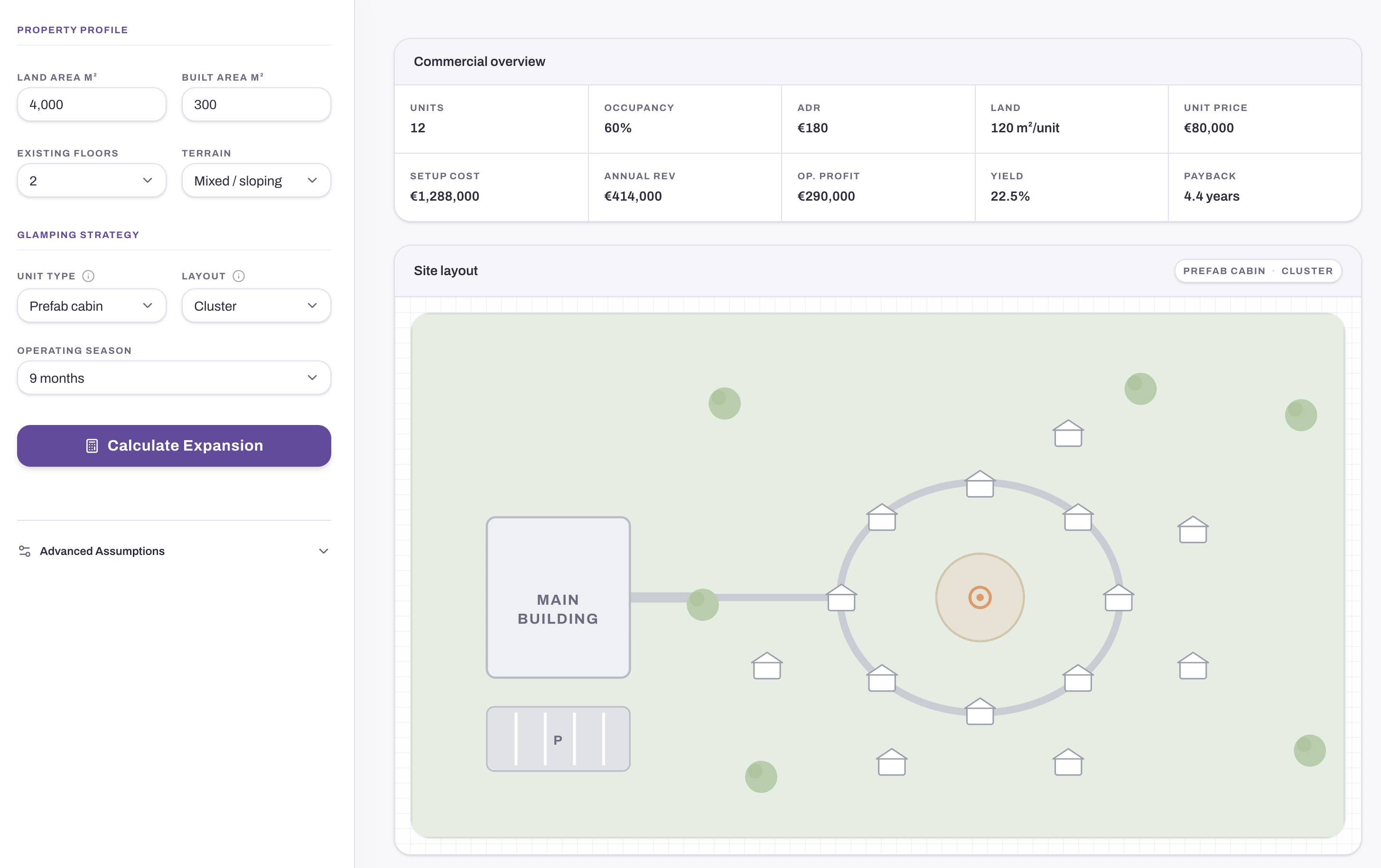
You have now turned a vague sentence about "development potential" into something that looks much closer to a small business case. You can use this Glamping Business Generator.
The same thinking applies to the existing buildings. Perhaps two rooms are currently being used for storage but could be converted into bedrooms. Maybe there is a barn that could become an event space, restaurant or additional accommodation. Perhaps the hotel has a large restaurant that isn't profitable and part of the space could instead become four additional guest rooms.
For a small hotel, every additional room can have a meaningful impact on revenue and valuation, so look at the entire property and identify underutilized assets such as land, storage areas, staff accommodation, restaurants, barns, basements, attics, meeting rooms, parking areas and gardens.
The buyer will obviously do their own research, but your job is to help them understand what the property could become without requiring them to discover every opportunity themselves.
Hotel sales take time, and you should plan for that before starting the process.
You will probably need several weeks just to organize the documents, prepare the financial information, take photographs, create the presentation and get everything ready for the market. After that, you still need to find buyers, organize visits, negotiate offers, complete due diligence and eventually close the transaction.
As a rough framework, I would consider six to nine months a very optimistic scenario, while somewhere between nine and eighteen months is probably a more realistic expectation for many properties. A difficult sale can easily take eighteen to twenty-four months or longer, and some hotels will simply not sell until something about the offer changes.
If a hotel has been on the market for two years without serious interest, it doesn't necessarily mean that nobody wants that type of hotel. More likely, something about the price, positioning, presentation or distribution isn't working.
In my view, three things have the biggest influence on how quickly a hotel sells: the price, the quality and reach of the broker, and the quality of the information you provide to potential buyers.
You might notice that location and property type are not on that list. Obviously both have a huge impact on value, but that impact should already be reflected in the price. There are buyers for unusual properties in unusual locations if the economics make sense.
You probably don't want to invest €500,000 into a major renovation immediately before selling, but that doesn't mean you should present the hotel in its worst possible condition.
There are usually many relatively inexpensive improvements that can change how buyers perceive the property and the business.
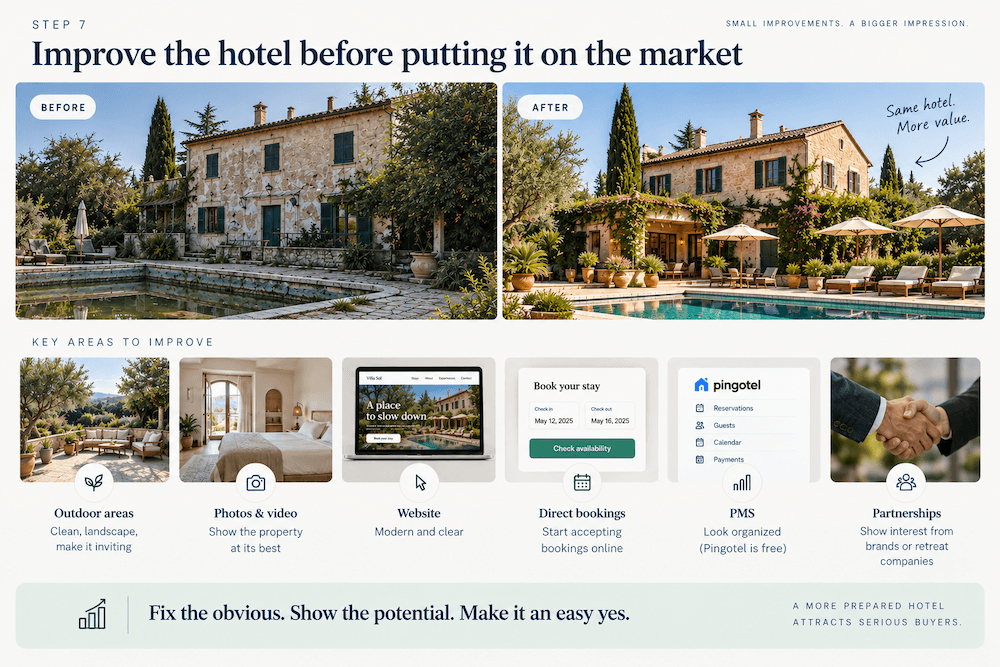
If the garden and outdoor areas look neglected, bring in a landscaping company. If your photos are ten years old, get new ones. If the website looks terrible, improve it. If you don't accept direct bookings, set that up before starting the sale.
The same applies to hotel operations. If reservations are managed through spreadsheets and WhatsApp, implementing even a basic PMS makes the business look much more organized. For example, a small hotel can use Pingotel.com for free and start managing reservations and accepting direct bookings without making a significant technology investment.
You should also think about partnerships that could make the property more attractive to the next owner.
If hotel brands, management companies or hospitality concepts have approached you over the years, contact them again and see whether they would be interested in providing an indicative proposal. You can then show a buyer that there is already a possible operator or brand interested in the property if they don't want to run everything themselves.
Commercial partnerships can have similar value. If your hotel has an agreement with a retreat company like Surf Office that reliably brings ten company offsites per year, document that relationship and explain how much business it generates. The easier it is for a new owner to understand where future demand can come from, the less uncertainty they need to price into the acquisition.
The goal is not to rebuild the entire business immediately before selling it. It is to remove obvious problems that are cheap to fix and make the hotel look like an organized asset rather than somebody else's unfinished project.
Pricing is probably the most important part of the entire strategy, and it is also where many owners make their biggest mistake.
Spend time getting independent hotel valuations of the real estate and the hospitality business rather than treating them as one number. Look at comparable hotels, recent transactions where available, profitability, price per room, development potential, condition of the property and the value of the underlying land.
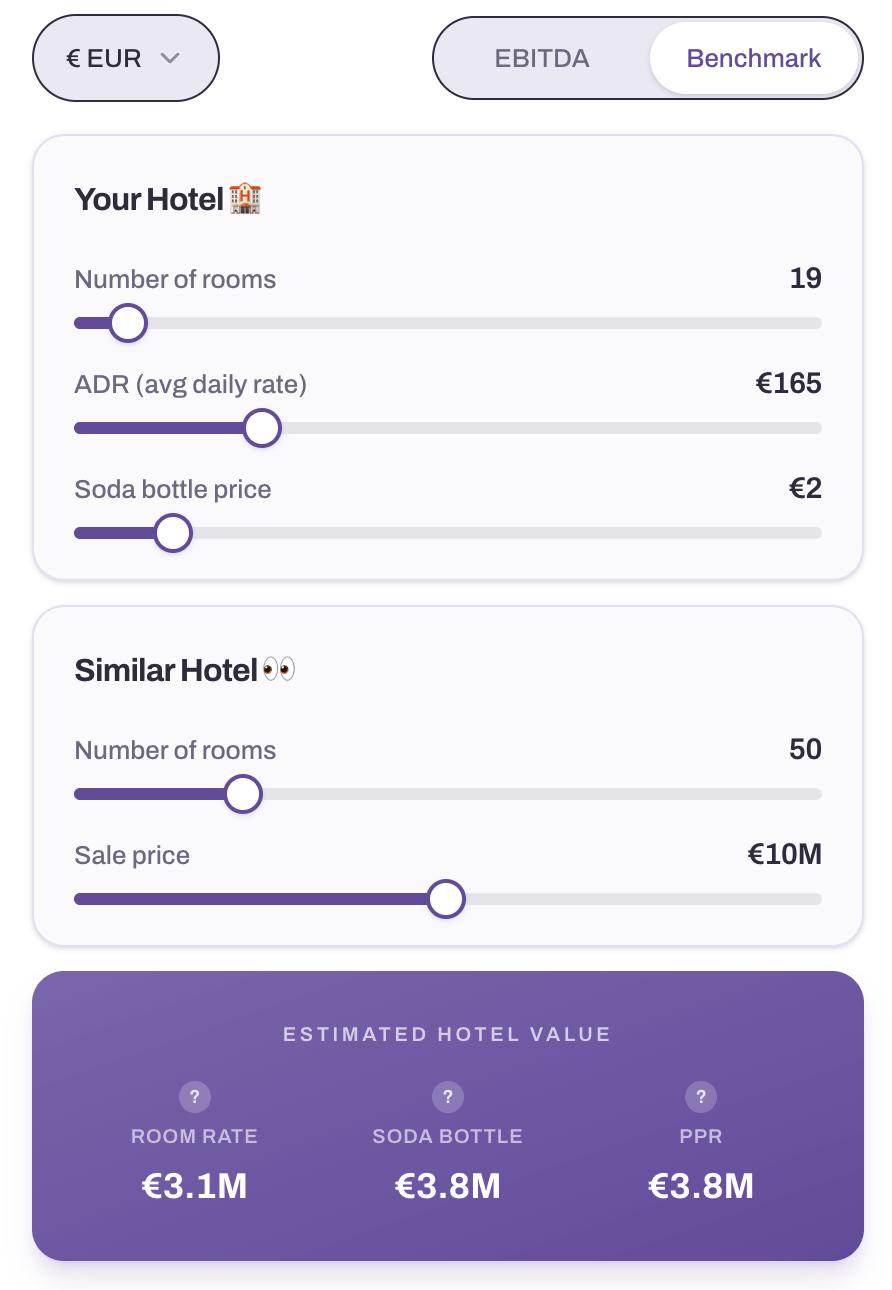
We cover this distinction between real estate value and business value, together with other common problems, in our guide to mistakes hotel owners make when selling.
Most importantly, don't fall in love with your asking price.
A common assumption is that there is no downside to starting very high because buyers can always negotiate. In reality, serious buyers often understand approximately what an asset is worth before contacting you, and if your asking price is dramatically above their valuation, they may not negotiate at all.
They simply move on.
Based on our research at Buy That Hotel, hotels listed for sale are on average around 25% more expensive than our estimated value of those properties. This helps explain why you see the same hotels sitting on listing websites for years, sometimes appearing again with a different broker and a slightly different description.
An attractive asking price can sometimes produce a better result than an ambitious one. If the property generates enough interest and several credible buyers want it, they can start competing against each other and push the final price higher.
Es gibt auch andere Ansätze. Sie können eine Auktion durchführen, die Gelegenheit ohne Preisvorstellung veröffentlichen oder Käufer dazu einladen, Angebote abzugeben. Ich persönlich ziehe es meist vor, zumindest einen Anhaltspunkt für den Preis zu geben, da dies dazu beiträgt, dass die Immobilie in den Marktplatzfiltern erscheint, Erwartungen festlegt und Käufer aussortiert, deren Budget bei weitem nicht ausreicht.
Der größte Fehler bei der Preisgestaltung besteht nicht darin, etwas unter dem theoretischen Maximalwert zu verkaufen. Der Fehler liegt darin, den Preis so hoch anzusetzen, dass ernsthafte Käufer gar nicht erst in den Prozess einsteigen.
Ein erfolgreicher Hotelverkauf hängt davon ab, die Immobilie richtig vorzubereiten, zu verstehen, wer als Käufer infrage kommt, und für genügend Aufmerksamkeit und Wettbewerb zu sorgen, um ernsthafte Angebote zu erhalten.
Entscheiden Sie, ob eine öffentliche oder eine diskrete Vermarktung sinnvoll ist, bereiten Sie den Datenraum vor, bevor die ersten Käuferanfragen eingehen, legen Sie fest, ob Sie professionelle Investoren oder Käufer mit Lifestyle-Interesse ansprechen, und entscheiden Sie, ob die Stärke Ihres Angebots in der aktuellen Performance des Hotels oder in seinem zukünftigen Potenzial liegt.
Konkretisieren Sie dieses Potenzial, beheben Sie offensichtliche Schwachstellen, die kostengünstig zu korrigieren sind, wählen Sie den richtigen Vertriebsweg und Makler, setzen Sie sich einen realistischen Zeitrahmen und investieren Sie mehr Zeit in die Preisgestaltung, als Sie für nötig halten.
Sie können zwar nicht genau steuern, wann der richtige Käufer auftaucht, aber Sie haben fast alles selbst in der Hand, wenn es darum geht, wie das Angebot in diesem Moment präsentiert wird.
Peter Fabor is a hospitality entrepreneur with 15+ years of experience building niche businesses across hotels, coliving, coworking, retreats, and hospitality tech. He is the founder of Surf Office, Buy That Hotel, Hotel Nuggets, and Pingotel. His work focuses on identifying underserved hospitality markets and building businesses around them.